Wednesday, July 23, 2008

Believe it or not ... things change

As an anthropology major one question or subject that people bring up to me the most is the question of evolution occurring today ... is it or is it not?

Just recently I had someone try their hardest to convince me that evolution cannot be real because if it was true then we would see evolution occurring today. Well, this is just a silly statement. The earth is 4.5 billion years old, evolution cannot simply stop – what an anthropocentric idea. 

As John Morley a British politician, writer and newspaper editor almost a century ago said, “Evolution is not a force but a process. Not a cause but a law.”

A large portion of human evolution has been, well, a human process. This does not mean that we are undermining the natural process of things, but throughout the entire history of human evolution, most frontal lobe developments can be attributed to human inventions.

We have not been forcing this, but enthusiastically trotting along. We made tools, which lead to the evolution of labor specialization and culture. Cultures lead us to technological advances.

Computer technology is rapidly rewiring our brains. For example, today most people don’t have excellent or innate wildlife survival skills compared to even a thousand years ago. And now, we have to remember less and less information such as a simple phone number, allowing room and time for other knowledge and even more creative inventions that change the way humans live.

All of these are signs of evolution; human induced, yes, compared to what one normally thinks about upon hearing natural selection, but evolution at its best and more rapid than ever.  

             The most obvious sign of evolution still occurring, however, is modern medicine ... we’re creating powerful diseases and microbes because of our innovative medicines. Antibacterial soap is an excellent example as described by the Center of Disease Control and Prevention website on the effects of overusing antibacterial products and antibiotics. (image from CDC)

" ... after years of overuse and misuse of these drugs, bacteria have developed antibiotic resistance, which has become a global health crisis."

If certain medicines and vaccines weren’t available today natural selection would have had the better of many people that survived only because of the medicine. Look at birth control.

The Pill, introduced in the 60s offered a completely revolutionized role for women. No longer was she expected to be pregnant at a young age, but women could take the Pill, go to college, and do virtually everything that held her back from being truly equal to man.

This has opened up for an entirely different gene pool and way of life.

As Terry Pratchett, an English writer said, “Most species do their own evolving, making it up as they go along, which is the way Nature intended.” 

Wednesday, June 18, 2008

Don't forget the "short" tales

At the other end of the spectrum are the pygmies. Pygmies are not to be confused with dwarfs. Pygmies "are properly a member of one of certain


small-sized peoples of Africa and Asia, but the word is often used imprecisely to mean dwarf or midget," according to dictionary.com. The word dwarf actually means, "someone checked in growth or stunted, or in some way not normally formed."

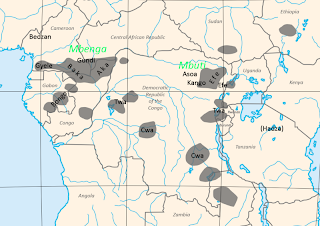
Many pygmy cultures in Africa and Asia are completely unheard of. The average adult pygmy height is 4 feet and 11 inches. Most pygmy cultures, however prefer their ethnic name, such as the Aka pygmy group. The Aka group is a nomadic tribe, like pygmy cultures are traditionally. Many live in the areas of Cameroon, Gabon, Republic of the Congo, Central African Republic, Equatorial Guinea and have market relationships with nearby tribes. 

They usually live in small huts made of branches and leaves, typically called a mongulu. Most pygmies are hunting and gathering tribes and many hunting techniques have symbolic meaning or traditions attached to them, such as the big elephant hunt. As well, pygmies do have language, usually it specifically relates to that of the rain forest.

The origins of pygmies is constantly at debate by researchers. Some point to food and resource competition or malnutrition, such as a lack of calcium. Another reaso
n may be simple evolution; adapting the the dense forests and high heat and humidity. 

Below is a map of general locations of pygmy tribes. 

Tuesday, June 10, 2008

Gigantopithecus--possible explanation for bigfoot "tall" tale

These ancient species could be found where China, India and Vietnam stand presently and date possibly all the way back to seven million years ago until 300,000 years ago.

Their long reign, though impressive, doesn't compare to its infamous height. The genus, Gigantopithecus, stood on average from seven to 12 feet tall, such as pictured at right, a reconstruction at the Museum of Man in San Diego, CA. This giant ape weighed anywhere from 1,200 pounds to one ton.

The genus is a hominoid, meaning it is grouped as a great ape as well as a hominid, which includes strictly bipedal species, or humans. The species is considered a great ape and close relative to modern humans. (These definitions are constantly at debate, but I use them here traditionally.)

It then includes three species of Gigantopithecus, though details of their differences have not yet been discovered. Its closest relative, it is believed, is the orangutan (note there is no 'g' at the end of orangutan, please pronounce it with diligence).

Gigantopithecus blacki is the most known species and is possibly the largest ape species that ever knuckle-walked this earth. Several jawbones have been found, mandibles, and many teeth.

Due to all the teeth found, scientists believe that Gigantopithecus had the same appetite as that of a giant panda. Cavities present in their molars, as they are found in the panda, suggest they ate bamboo, certain vegetables, and because of other wear and tear, seeds and fruits.

The extinction of the species is not quite known. Many suggest simple evolutionary terms and agreements as the reason, meaning as the climate and world changed over the course of their history, other species who were well-adapted to the newer surroundings out ran them in the race for resources. One large contributing factor may have been due to their contemporaneous relatives, Homo.

Homo erectus, dating to two million years ago to 200,000 years ago, had continuous occupation in China and east Asia areas 800,000 to 250,000 years ago (dates are approximate). It is suggested, like many other large mammal species that have lived alongside humans, that Homo erectus hunted the species and may be partly to blame for its extinction.

Critics believe that this species could be the explanation of stories/claims like that of Bigfoot and the Yeti, and may even be an explanation of "dragon bone" use in Chinese apothecaries. However, as folklore goes, even with surmountable evidence, its virtually impossible to clarify or prove it wrong ... as is intelligent design.